How to Pick a Show With Your Partner When You Can't Agree on Anything
The honest 2026 guide to choosing a TV show as a couple. Why \"I'll watch anything\" is a lie, the three systems that actually work, and what to do with mismatched taste.
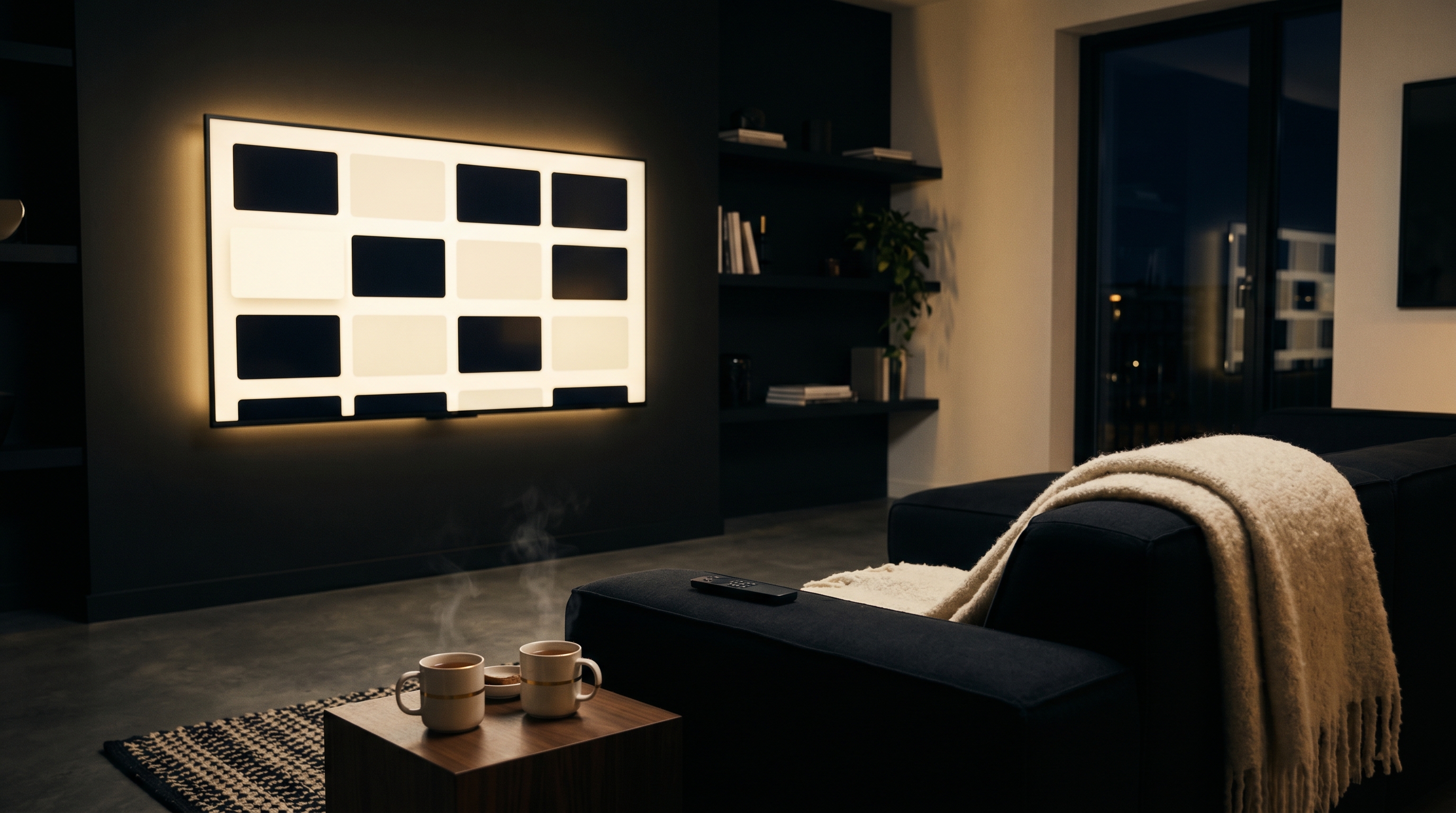
It is 9:14pm on a Sunday and you have been on the Netflix home screen for forty minutes. The dog has given up and gone to bed. Your partner said "I really don't mind" twelve minutes ago and now keeps sighing every time you hover over a thriller. You opened HBO Max in another tab to make a point. The point did not land. By 9:38pm, you will watch a forty-minute episode of something you have both already seen, because the show you would have actually enjoyed is now hostage to whoever blinks first.
This is, statistically, how most shared streaming nights end. A 2023 YouGov survey put the average couple at twenty-four minutes of nightly browsing before settling on anything — and the "settling" itself is the issue. The thing you eventually press play on is rarely what either of you wanted. It's the lowest-friction option you could both pretend to be happy with.
We've spent two years running synced viewing rooms for couples, and the most common piece of feedback we get isn't about the technology. It's about the picking. Couples who watch shows together — same roof, long distance, whatever — fight more about choosing than about anything that happens after pressing play. Here's what actually works.
Why "I'll watch anything" is the most dangerous sentence in the relationship
The single biggest source of streaming-night conflict is one of you saying "I'll watch anything" and then visibly hating the thing you picked. It happens twice a week in most households, and it sets the same trap every time.
The "I'll watch anything" partner isn't lying on purpose. They genuinely don't have a fixed pick. What they have is a negative space of options — twenty things they don't want — that they haven't told you about, because they don't think of them as preferences. They think of them as obvious. "Obviously not the murder one." "Obviously not subtitled, I'm tired." "Obviously not the show I tried with my ex." None of this is in your head.
So you offer three options, all of which fall inside their invisible no-zone, and watch their face do increasingly subtle disappointment. You ask "what about this?" and they say "sure, fine." You press play. They check their phone within four minutes. By the end of episode one you're annoyed at each other for reasons neither of you can articulate without sounding petty.
The fix is to make the constraints explicit before the picking starts. Not preferences — constraints. "Nothing too gory tonight." "Subtitles are fine but only one new show this week." "I want comfort, not stakes." Two sentences each, before either of you opens Netflix. It feels artificial the first time. By the third Sunday it's faster than scrolling.
The disagreement is rarely about genre
When couples tell us "we have completely different taste," the conversation almost always reveals that they have overlapping taste in genre and incompatible taste in pace, intensity, or commitment length. The labels are wrong. They're using "I like dramas, she likes comedies" as shorthand for "I want a slow-burn six-hour limited series and she wants three twenty-minute episodes she can fall asleep during."
Try diagnosing along these axes instead, the next time you can't pick:
- Intensity tonight. Background show, leaning-in show, or full-attention show? These are wildly different products. Mixing them is the actual mismatch — not the genre.
- Length of investment. A six-hour British miniseries and a five-season network procedural are not the same commitment. One of you might love both; the other might love procedurals and resent a binge cliff at hour three.
- Cognitive load. Subtitles, complex timelines, large casts, in-jokes — anything that fails if one of you reaches for their phone. A high-load show plus a low-energy night is a small disaster.
- Emotional cost. "Sad show" isn't a genre. It's a tax that some nights you can afford and some nights you cannot. Couples who name this — "I cannot handle anyone dying tonight" — fight a lot less.
If you can match on these four, the genre sorts itself out. If you keep mismatching on these and arguing about genre, you'll keep going in circles.
The three picking systems that actually work
There are dozens of "rules" floating around the relationship-advice corner of the internet for how couples should pick shows. Most of them collapse into one of three workable systems, plus a lot of well-meaning noise. Here are the three.
1. Veto-pick alternation
One person picks the show; the other gets one veto, used sparingly, and an unconditional out at minute thirty. Then it flips for the next show. This is the system most couples land on after a year of fighting, and the reason is it's simple and survives in the wild.
The discipline is in the veto. If you veto everything your partner picks, the system breaks within two weeks. The healthy ratio in our data is roughly one veto per five picks. Anything more than that and the picking partner stops trying, defaults to the safe-but-boring choice, and you end up rewatching Friends for the eighth time.
2. The five-minute trial rule
You agree, in advance, that the first five minutes of any new show are a free trial. No commentary, no faces, no phones. At minute five, either of you can call it dead with no argument. This works because the resistance to a new show is almost always front-loaded — the unfamiliar cast, the world-building exposition, the dread of a six-hour commitment to something you can't yet judge.
Most shows survive the five minutes. The ones that don't get killed early, which is the entire point. Couples who use this rule pick faster, watch worse shows less often, and develop genuine shared taste over time because they're seeing the opening of more things instead of relitigating the same three safe picks.
3. The shared shortlist
This is the most under-used system and quite possibly the best one. You maintain a single shortlist — a notes app, a shared Notion page, a sticky note on the fridge, whatever — of shows you've both agreed are candidates. The list has a maximum of ten items. New entries require both of you to add them. When it's time to pick, you only pick from the list.
The cost is twenty minutes of curation on a Saturday morning, every six weeks. The payoff is the elimination of the entire 9:14pm scroll-fight. The list is also self-correcting: shows neither of you reaches for get rotated off, and the ones that survive multiple rotations are the ones genuinely worth watching together. Over a year, the list becomes a quiet portrait of your actual shared taste — which is more than most couples ever discover by accident.
You can combine these. The strongest combination in our data is the shortlist plus the five-minute rule: you pick from the shortlist, and the five-minute trial is the safety valve when you got the entry wrong.
What to do when you genuinely have incompatible taste
Some couples don't have a picking problem. They have a compatibility problem. One of them wants prestige drama; the other wants romance. One wants horror; the other will not be in the room if jumpscares are involved. No amount of veto rotation fixes this.
If this is you, the move that works is to stop trying to share everything and start being deliberate about what you do share.
Pick one show that's yours. One. Not the show you both reach for at 9pm — the show you protect, on a fixed slot, with all the rituals (snacks, no phones, no other shows during the week without each other). This is the load-bearing ritual. It only has to be one.
Let solo shows be solo shows. The biggest source of conflict in mismatched-taste couples isn't the existence of solo shows; it's the pretense that they aren't happening. If you're going to watch Better Call Saul alone because your partner won't, name it. Don't sneak. This is the inverse of stream cheating — declared solo viewing is fine; declared solo viewing of the shared show is not.
Don't perform interest. The temptation, when your partner is excited about a show you find tedious, is to pretend to like it for their sake. They can tell. They'd rather watch it alone or with a friend than watch it next to a polite stranger. "I'd love to hear about it but I'm going to read tonight" is, weirdly, a more loving sentence than three months of fake enthusiasm.
The architecture beats the willpower
The 9:14pm scroll-fight is, fundamentally, a willpower problem disguised as a taste problem. You both have decision fatigue from the day. You're both tired. You're both more likely, in that state, to default to whatever requires the least argument — which is rarely what either of you actually wants.
The fix isn't to be better at picking when tired. It's to do less picking when tired. The shortlist system above is one form of this. A standing weekly show — the same show, the same night, no decision — is the strongest form.
This is also where synced co-watching tools quietly help, even for couples on the same couch. The act of opening a room, naming the show, sending the link — five seconds of friction — turns the picking from a passive scroll into an active commitment. You can't accidentally drift into a forty-minute browse if the show is already cued up in a room with a join link sitting in your phone. The friction is on the right thing: scrolling instead of starting.
The same logic underwrites the alternative tools in this space — Teleparty, Scener, Hyperbeam — they all reduce the picking decision to a deliberate act rather than a passive negotiation. Whichever you use matters less than the fact that opening the tool is the decision.
A note on streaming algorithms
Worth saying directly: the streamers do not want you to find the show fast. The Netflix home screen is optimised to keep you on the Netflix home screen — every press-in and back-out logs an engagement event and rearranges the rail to give you new things to bounce off of. Couples who solve the picking problem mostly solve it by spending less time inside the recommendation surface and more inside their own pre-committed list.
The WatchNest free tier handles couples by default, and we'd say the same about any tool: the point is to make the starting of a show the path of least resistance, and the deciding of one the deliberate act. The current design of every major streamer has those exactly inverted.
Common questions
My partner picks the same kind of show every time. How do I get them to try something new? Use the five-minute rule explicitly. Frame it as "I'll commit to the first five minutes, no faces, and if I'm not in I'll say so." Most people resist new shows because they don't want to lose two hours; they're fine giving five minutes. Once you've watched the opening of three or four new shows, taste starts to shift on its own.
We always pick something we've already seen. Is that bad? Not necessarily. Comfort-rewatch is a legitimate use of streaming time, especially on tired weeknights. It becomes a problem when it's the only mode — when you've stopped exploring because the picking fight isn't worth it. The cure is one new show on the shortlist, not banning rewatches.
One of us falls asleep during every show. How do we pick something they'll stay awake for? You probably can't. The pick isn't the issue; the slot is. Try an earlier time, a shorter format, or accept that the falling-asleep partner gets the "background show" slot and someone else gets the "leaning-in show" slot on a different night. Forcing the wrong slot is what breaks the picking.
We argue more about what to watch when we're stressed. Is that normal? Almost universal. Picking is a low-stakes proxy for "do you actually know what I want." When the deeper question feels unanswered, the proxy fight gets louder. Doing the constraints conversation up top — two sentences each, before the scroll — defuses 80% of these.
Is the shortlist system over-engineered for what's supposed to be relaxing? Twenty minutes of curation every six weeks, in exchange for never having a 9:14pm scroll-fight again, is a good trade. The "relaxing" version of the current state is forty minutes of nightly browsing followed by a show neither of you wanted. The light structure is what makes the relaxing part possible.
The picking is the relationship in miniature
The closing thought: how a couple picks a show is a tiny, repeating model of how that couple makes any small decision together. The patterns rhyme. The partner who says "I'll watch anything" and then sulks is the same partner who says "I don't care where we eat" and then critiques the restaurant. The couple who fights for forty minutes about Netflix is doing a low-stakes rehearsal of every other recurring negotiation in their life.
Which is why the fix isn't a different show. It's a quieter version of the conversation that the picking is standing in for. Constraints up front. One system, lightly held. A shared list that lives somewhere both of you can see. The understanding that incompatible taste is not a failure of love; it is just information about which show to make the shared one and which to make yours alone.
Done well, the picking takes a minute. Done badly, it takes an evening, and the show is the worst part of it. The choice you're really making, on every Sunday at 9:14pm, is which version you want your relationship to default to. Pick deliberately. The show will take care of itself.
Start your private watch party
Free for two viewers, premium for groups. Synced playback, chat, video calls — all in one extension.
Read next
How to Watch Reality TV Together Long Distance in 2026
Love Is Blind drops, Bachelor watch parties, group-chat spoilers, and the dating-show ritual that actually holds. Honest field notes for long-distance couples.
How to Watch K-Dramas Together Long Distance (2026 Guide)
Weekly Viki drops, 16-episode commitments, time zones, and the subtitle problem. The honest 2026 guide to watching K-dramas with your partner long distance.